
Choose a country to view content specific to your location
Immunoassay blockers are used in diagnostic assays to reduce non-specific binding and other interference that can lead to false-positive results. Specifically, interference from human anti-mouse antibodies (HAMA), rheumatoid factor (RH), and heterophilic antibodies (HA) are a major concern in both paired monoclonal sandwich assays and competitive assays. Specialized blockers are required in these assays to reduce any interference and to ensure the assay’s accuracy.
Immunoassay blockers are usually produced using animal sources however this presents risks like contamination, batch variability and poor scalability. Recombinant blockers in contrast are 100% animal-free and manufactured under strict controls, enabling precise reproducibility across experiments, and scalability, making it ideal for regulated diagnostic immunoassays.
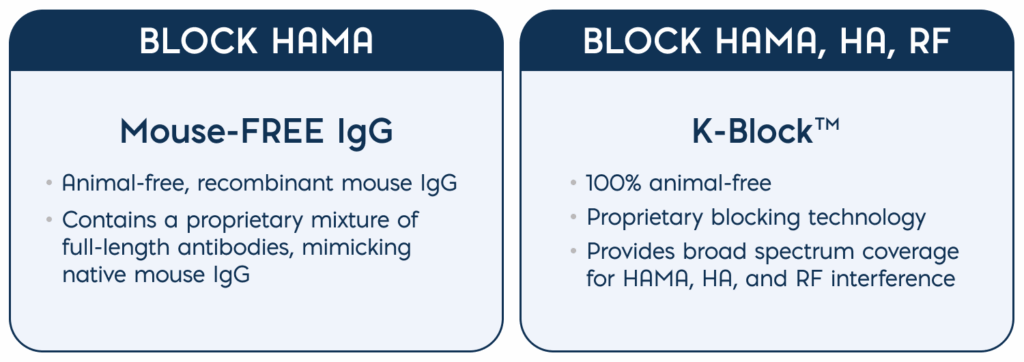
Meridian offers new recombinant blocker options: Recombinant Mouse-Free IgG and K-Block™.
Contact us to learn more about Meridian’s molecular or immunoassay reagent portfolio. We want to hear from you!
| Name | Type | Format | Host/Source | Isotype | Tested Apps | Unit | Catalog | Buffer | Immunogen | Recombinant | Description | Notes | Safety Data Sheet | COA/Test Release | Product Information Sheet | New Product | Recommended Product | Order a Sample | ||
|---|---|---|---|---|---|---|---|---|---|---|---|---|---|---|---|---|---|---|---|---|
| Mouse-FREE IgG | Blocker | Purified, Liquid | Cell Culture | N/A | Blo | MG | BN1300 | 10 mM Sodium Phosphate, 150 mM Sodium Chloride, pH 7.0 7.4 | Yes | Mouse-FREE IgG is a proprietary animal-free blocker with powerful blocking characteristics against human-anti mouse antibodies (HAMA) | Safety Data Sheet — | COA/Test Release | — | 0 | 0 | |||||
| K-BLOCK (TM) | Blocker | Purified | Cell Culture | N/A | Blo | MG | BN1200 | 10 mM Sodium Phosphate, 150 mM Sodium Chloride, pH 7.0 7.4 | Yes | K-Block has a proprietary blocking technology across various assay types and powerful assay interference blocking characteristics against human anti-mouse antibody (HAMA), rheumatoid factor (RF) and heterophilic antibodies (HA). The blocking effectiveness of K-Block has been proven in ELISA and lateral flow assay formats. The enhanced effectiveness of K-Block allows to add this blocker at reduced concentrations to achieve HAMA blocker cost reductions as well as broad coverage against HA/RF. | Safety Data Sheet Product Information Sheet | COA/Test Release | Product Information Sheet | 0 | 0 |
Animal-free blockers offer improved specificity over traditional blockers, as they will not cross-react with animal-sourced antigens and antibodies in the assay. The potential for non-specific binding is reduced and the signal-to-background is improved.
Animal-derived reagents can have batch-to-batch variability, impacting assay consistency. In contrast, animal-free reagents are more chemically well-defined and contain a finite number of traceable ingredients, resulting in greater reproducibility, regulatory advantages and increased speed-to-market.
Animal-derived components used in traditional blockers can carry contaminants, such as viruses, prions, and endotoxins, that can affect the accuracy of an assay. Animal-free blockers strongly reduce this risk.
Conventional mouse serum and mouse IgG are typically derived from animal sources, often sourced internationally. Consequently, their availability is susceptible to supply chain disruptions caused by geopolitical events or biological threats. In contrast, recombinant blockers are produced through fully scalable and tightly controlled manufacturing processes, enabling flexible production volumes and ensuring resilience against disruptions affecting animal populations.
Regulations such as the European Union (EU) Directive2010/63/EU, are encouraging the use of animal-free reagents. Using an animal-free blocker aligns with the ethical concerns related to using animals in science.
Immunoassay blockers are used in diagnostic assays to reduce non-specific binding and other interference that can lead to false-positive results. Meridian’s newest animal-free solutions, Recombinant Mouse IgG and K-Block™, have proven high performance against similar animal-based commercial blockers from top competitors:
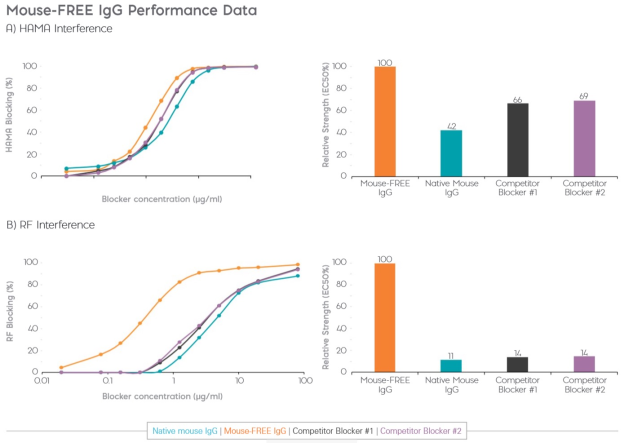
Figure 3. A double mouse monoclonal sandwich assay was used to compare the performance of Meridian’s Recombinant Mouse-Free IgG against serum-derived purified native mouse IgG and two competitor HAMA blockers. (A) Human HAMA-positive or (B) RF-positive serum was preincubated with the individual blockers for 20 minutes at room temperature. Blocker concentrations ranged from 0.0003–1.25 μg/mL for the HAMA assay and 0.0195–80 μg/mL for the RF assay. The effectiveness of each blocker was determined by comparing the relative suppression of the HAMA or RF signal – lower EC50 values indicate greater interference suppression. The results demonstrate that Mouse-Free IgG is significantly more effective than native mouse IgG and the two competitor blockers at blocking HAMA and RF interference.
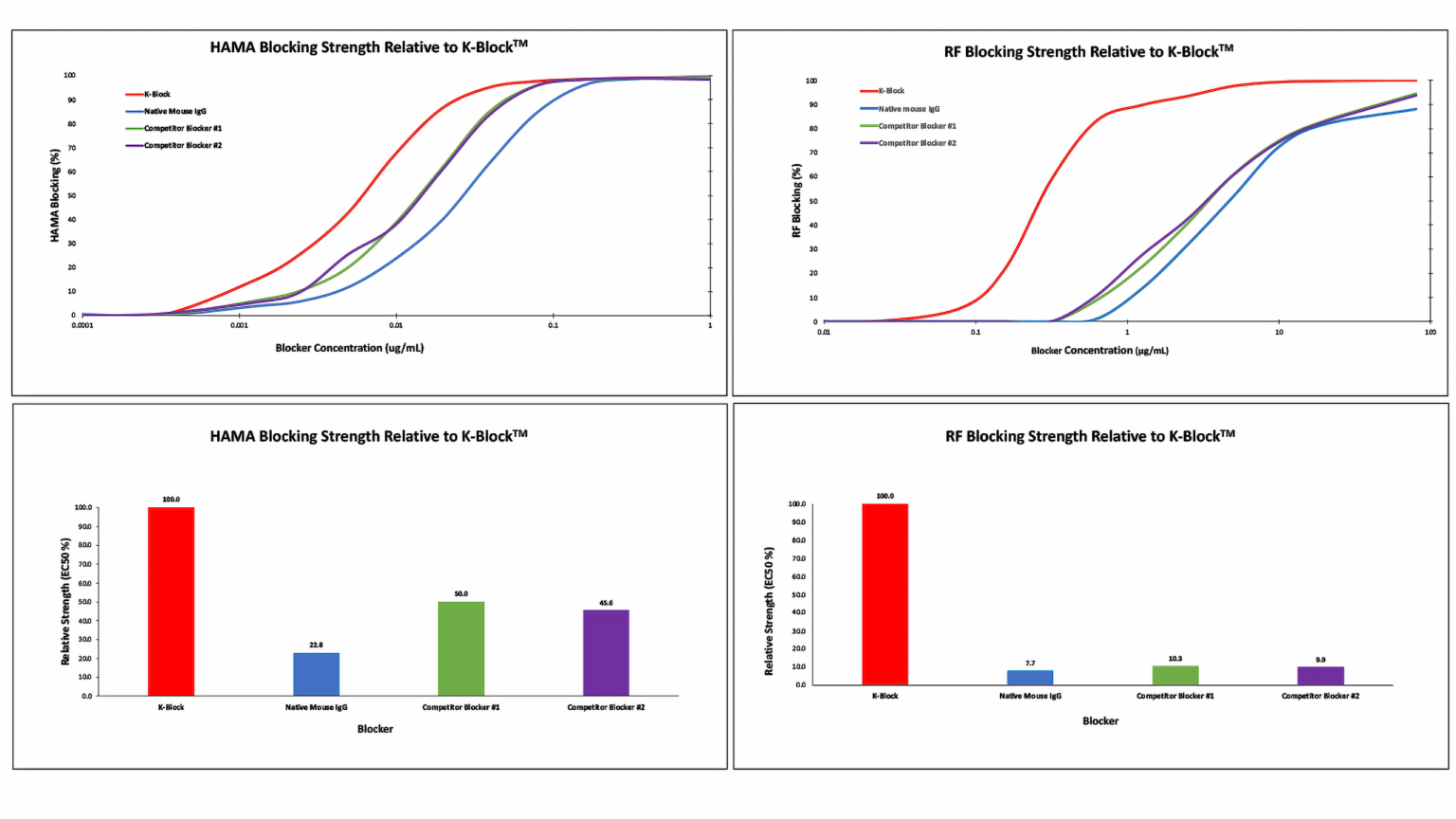
A double mouse monoclonal sandwich assay was used to compare the performance of Meridian Bioscience’s K-Block™ (100% animal-free, recombinant blocker, MLS Cat. No. BN1200) against serum-derived purified native mouse IgG and two competitor recombinant mouse IgG HAMA blockers. (A) Human HAMA-positive or (B) RF-positive serum was preincubated with the individual blockers for 20 minutes at room temperature. Blocker concentrations ranged from 0.0001-1.25 µg/ml for the HAMA assay and 0.01-80 µg/ml for the RF assay. The effectiveness of each blocker was determined by comparing the relative suppression of the HAMA signal to the signal of samples with no blocker. The results demonstrate that at lower concentrations, K-Block™ was more effective than native mouse IgG and the two competitors’ recombinant HAMA blockers. At higher concentrations, K-Block™ is as effective as the other blockers.
Mouse IgG can be added up to 10X the concentration of the monoclonal antibody being used in the assay to increase blocking effectiveness.
Recombinant Mouse-Free IgG is specifically engineered to represent all the major isotypes in native mouse IgG, and has optimized ratios to ensure peak performance. As a result, it is 20% more effective than native mouse IgG at blocking HAMA and RF.
For diluted samples, K-Block should be used between 0.5 µg/ml and 20 µg/ml. For non-diluted samples, K-Block should be used between 5 µg/ml and 200 µg/ml final concentration.
For best performance, the blocker should be included as part of the sample or conjugate diluent. In lateral flow assays, the HAMA blocker may be added to the conjugate pad, to a sample diluent or pretreatment buffer, and/or applied to the membrane as a blocking stripe located before the test stripe.
Please fill out the form about your inquiry. Upon submission, a member of our team will be in touch with a quote for your product sample.
| Type |
|---|
| Format |
| Host/Source |
| Isotype |
| Tested Apps |
| Unit |
| Catalog |
| Buffer |
| Immunogen |
| COFA Description |
| COFA Notes |
| Recombination |
| SDS |
| COA |
| Product Information Sheet |
| Request Sample |