
dATP, 100mM, Lithium Salt
Ready-to-use sequencing grade ultra-pure Deoxyadenosine triphosphate (dATP), 100 mM solution, supplied as lithium salts in purified water at pH 7.5, enzymatically synthesized from premium quality raw materials, using highly specific production systems in our purpose-built facilities. The manufacturing process eliminates impurities and PCR-specific inhibitors such as modified nucleotides, tetraphosphates and pyrophosphates commonly observed in other commercially available dNTP products (>99% purity determined by quantitative HPLC). Lithium salts have greater resistance to repeated freezing and thawing cycles than sodium salts, and lithium salt dNTP preparations remain sterile over the entire shelf-life due to the bacteriostatic activity of lithium towards various microorganisms.
Have questions about a product?
Meridian's dATP, 100mM, Lithium Salt
- Greater than 99 % purity, ideal for use in qPCR applications
- Free from PCR inhibitors for maximum assay performance
- Enzymatically synthesized from premium quality raw materials
- Free from DNase, RNase and Nickases
Highly sensitive multiplex qPCR reaction
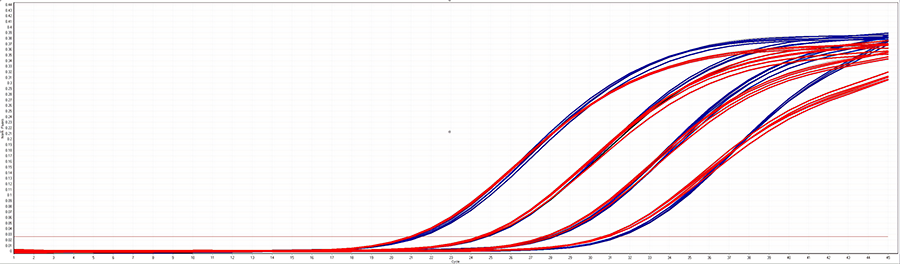
A 10-fold serial dilution of human genomic DNA amplified with four different probes, both in singleplex reactions (blue line) and quadruplex reaction (red line) using dATP, dCTP, dGTP and dTTP in lithium salt. The results illustrate the same high sensitivity, excellent reproducibility and Ct values for both the singleplex and multiplex reactions with no reduction of efficiency often associated with multiplexing.
dATP, 100mM (Lithium), MDX046
Ultra-pure dATP (2-Deoxyadenosine-5-Triphosphate) lithium salt solution, enzymatically synthesized from premium quality raw materials.
Documents & Resources
Description
dATP, 100mM, Lithium Salt achieves high dNTP quality, with minimal batch-to-batch variations. They are manufactured to the highest standards and are perfectly suited for even the most demanding applications, such as highly sensitive qPCR.
Specifications
| Description | Ultra-pure dATP (2’-Deoxyadenosine-5’-Triphosphate) lithium salt solution is enzymatically synthesized from premium quality raw materials, using highly specific production systems in our purpose-built facilities. |
| Composition | C10H12N5O12P3Li4 |
| Molecular weight | 514.916 g/mol |
| Concentration (at λmax, pH 7.0, ԑ = 15.4 E x mmol-1 x cm-1) | 100 mM ± 5% |
| Appearance | Clear, colorless solution |
| Application | cDNA synthesis, PCR, long-range PCR (>20 kb), high fidelity PCR, RT-PCR, qPCR, RT-qPCR, LAMP, microarrays, long NGS |
| Presentation | 1 vial |
| pH of Solution (at 20°C) | 7.5 – 8.0 |
| λmax (at pH 7.0) | 259 ± 1 nm |
| A250/A260 | 0.78 ± 0.03 |
| A280/A260 | 0.15 ± 0.02 |
| Consistency | Single band with PCR amplification of a 3 kb amplicon with a serial dilution of dATP. |
| DNA contamination | None detected in qPCR amplification with traces overlay with the negative control on E. coli and mouse genomic DNA specific targets. |
| DNase/RNase/Nickase activity | None detected |
| Purity dATP(HPLC Area % at λmax) | ≥99% |
| dNDP + dNMP(HPLC Area % at λmax) | <1% |
| DNase/RNase Contamination | No detectable degradation |
Catalogs & Brochures
FAQs: dATP, 100mM, Lithium Salt
Why is the purity of dATP important?
dATPs or adenosine triphosphate is a “building blocks” for DNA. Purity and stability of all of the dNTPs are two of the essential factors to achieve a successful PCR. The use of a highly purified dNTPs for PCR preparation is particularly recommended for sensitive techniques such as long-range PCR, RT-PCR, multiplex PCR and real-time applications. The purity of dNTPs is also important when the starting amount of template is minimal.
What concentration of dATP is normally used in a PCR?
The standard concentration of a dATP for PCR reactions is 0.2 mM. If you add equal volumes of 100 mM dATP, dCTP, dGTP and dTTP, the final stock is a 25 mM of each dNTP, which corresponds to a 100x working concentration, so you need to add 0.2 µL to a 20 µL standard PCR reaction.
Can I increase the DNA yield by adding higher concentrations of dNTPs for PCR?
It depends. You probably can increase the DNA yield, but you will have to optimize the complete PCR reaction, adjust the buffer, the Mg2+ and so on. It is not a matter pertaining only to nucleotides.
Does dNTP quality affect processivity?
Yes. The sodium salt dNTP products are a standard grade and so we recommend these dNTPs for PCR. For more sophisticated reactions such as amplification of long templates, real-time PCR and NGS, we recommend lithium salt dNTP products.
Is the pH of the dATP solution important for stability?
Yes. The optimal pH for storage of nucleotides is from pH 7.0-8.2 (pH at 20°C). An acidic pH will cause hydrolysis of dATPs (deoxyadenosine triphosphate) to dADPs (deoxyadenosine diphosphates) and dAMPs (deoxyadenosine monophosphates), rendering them less suitable for PCR applications. During freezing/thawing cycles, the pH of the dATP solution can differ from the pH at 20°C. Sodium salts are temperature sensitive, so care needs to be taken when repeatedly frozen and thawed and sodium salt dATP is better aliquoted into smaller volumes and kept frozen in order to extend their shelf life.
What are the advantages of enzymic synthesis over chemical synthesis of dNTPs?
The enzymatic synthesis of dNTPs uses highly specific enzymatic systems which eliminate impurities and PCR inhibitors, such as modified nucleotides, PPi and deoxynucleoside tetraphosphates. PCR reactions are impeded by the presence of contaminants resulting from chemical manufacturing processes, such as traces of dNDPs, pyrophosphates or other ionic species (e.g. acetate). Such contamination may lead to poor yields or to no PCR product at all. Unless thoroughly purified, chemically synthesized dNTPs often contain deoxynucleoside tetraphosphates which are powerful PCR inhibitors. Chemical synthesis can also lead to deamination and other nucleotide modifications whereas enzymatic synthesis of dNTPs bypasses these risks.
I need to dilute my dATPs to a different concentration, what should I use as a diluent?
We recommend that you dilute your dATP using molecular biology or PCR grade water.
Can your dATP be used for lyophilization?
Yes, all of our dNTPs are glycerol-free and so can be lyophilized.
Get In Touch With A Specialist
Have questions about a product? Want to learn more about Meridian’s molecular or immunoassay reagent portfolio? We want to hear from you!
By submitting your information in this form, you agree that your personal information may be stored and processed in any country where we have facilities or service providers, and by using our “Contact Us” page you agree to the transfer of information to countries outside of your country of residence, including to the United States, which may provide for different data protection rules than in your country. The information you submit will be governed by our Privacy Statement.